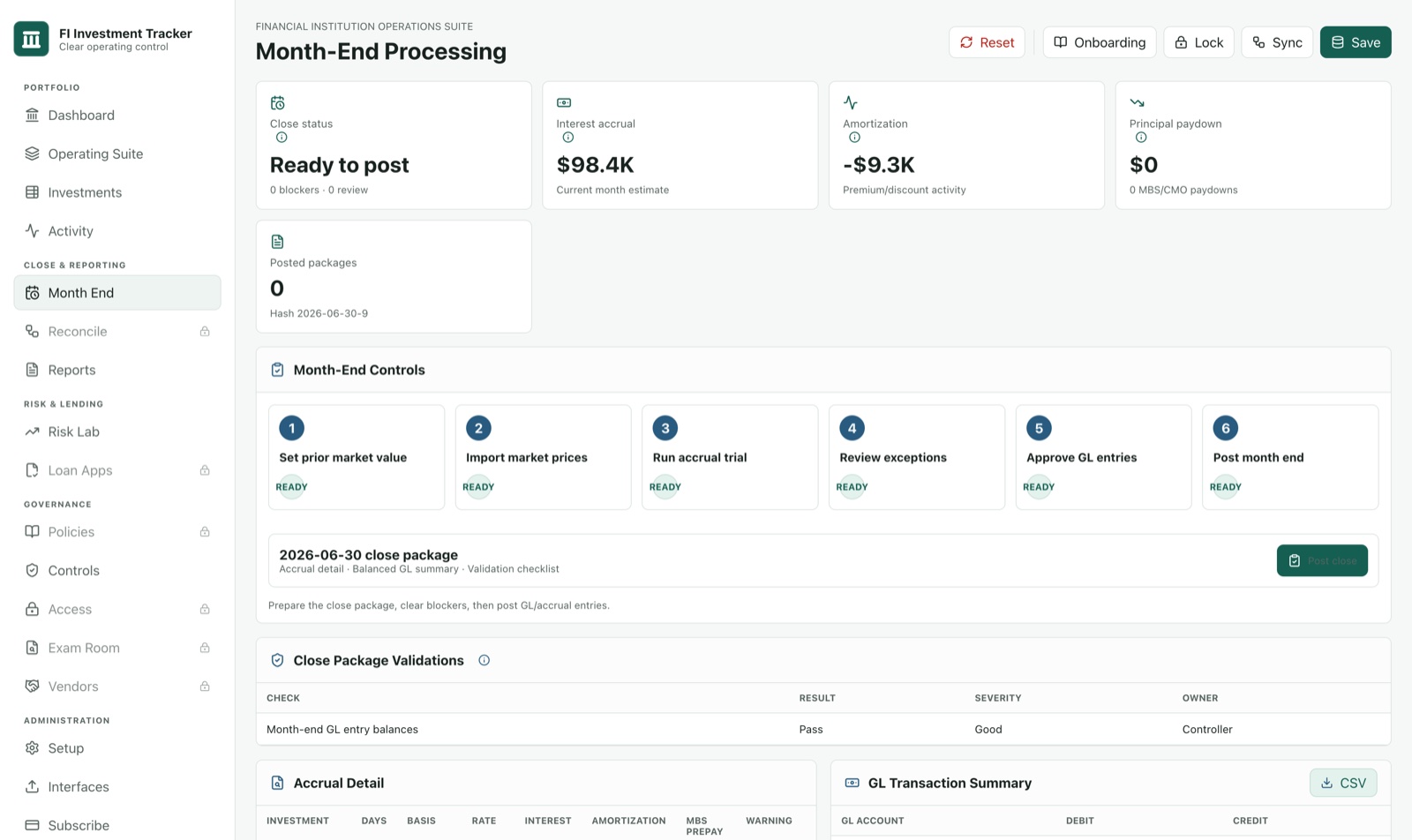
Month-end close workflow
Reconciling the investment subledger to the general ledger
Generic month-end close guidance tells you to compare balances and investigate discrepancies. That advice is useless on a securities portfolio, because it does not tell you which accounts break, why they break, or what order to work them in. This guide is the securities version: the specific general ledger accounts an investment subledger has to tie to, the specific reasons each one goes out, a tie-out sequence that resolves them in a workable order, and how to leave behind a reconciliation that functions as exam and audit evidence instead of a checkmark.
1
Prove the subledger internally with a roll-forward before you compare anything to the general ledger.
2
Tie by classification, not in total, and prove accrued interest receivable independently rather than assuming it.
3
Document every difference with an amount, a cause, and a disposition, then run the published audit test on yourself.
1. The accounts the subledger has to tie to
An investment portfolio does not reconcile to one number. It reconciles to a set of related accounts that have to be internally consistent with each other, which is why a single control-account comparison so often passes while the underlying records are wrong.
- Investment control accounts at amortized cost, separately for held-to-maturity and available-for-sale. These carry amortized cost, which means purchase price adjusted for amortization of premium or accretion of discount and reduced by principal already returned.
- Unamortized premium and discount, if your chart of accounts carries them in separate accounts rather than netting them into the control account. Both structures are workable; mixing them across classifications is not.
- Accrued interest receivable on investments. The account a recalculation test targets, and the one most likely to hold a small persistent error.
- Investment interest income, and the amortization and accretion accounts if you capture them separately from income.
- Realized gain and loss on sales, calls, and maturities.
- The available-for-sale valuation account and the corresponding equity movement for the fair-value adjustment.
- Clearing accounts, if you use them, for purchased accrued interest and unsettled trades. These are supposed to return to zero, and when they do not, they are usually holding the explanation for a break somewhere else.
2. Why each one breaks
These are the recurring causes, not a generic list. If your investment reconciliation has an open difference right now, it is very likely on this list.
- A manual journal entry posted directly to the investment control account. Someone booked an adjustment straight to the general ledger without a corresponding subledger transaction. This is the single most common cause and the easiest to prevent, because the control account should only ever be moved by the subledger.
- Trade date in one system, settlement date in the other. Any purchase or sale that straddles period end creates a break, and it reverses next month, which is why it gets tolerated for years instead of fixed.
- Accrued interest purchased at settlement charged to interest income. Interest paid to the seller for the period before you owned the security is not your income. Booked to income, it overstates income at purchase, leaves accrued interest receivable short, and then distorts the first coupon received.
- A factor paydown applied in the subledger but not posted, or posted in the wrong month. Factors arrive on their own schedule. If the subledger applies a factor with one effective month and the entry lands in another, the control account and the subledger disagree by exactly the paydown.
- A called or matured security retired in one place only. Calls are the usual culprit because they arrive unannounced and are handled by whoever notices the cash.
- Realized gain or loss computed on the wrong basis. Gain or loss on a disposition is measured against amortized cost at the disposition date, not against original cost and not against a stale book value. Getting this wrong misstates both the gain and the remaining carrying amount.
- The fair-value adjustment posted against the control account. If the available-for-sale mark is booked into the same account that is supposed to hold amortized cost, that account can never tie to a subledger reporting amortized cost. It needs its own valuation account.
- A price file with a valuation date that is not the reporting date. A mark taken two business days early is a real difference, and it is invisible unless the price source and price date are recorded.
- Amortization posted in summary against subledger detail. When the general ledger receives one monthly total and the subledger holds hundreds of security-level amounts, breaks appear as a scatter of small rounding differences rather than one identifiable item, which makes them far more expensive to chase.
- A day-count mismatch on accrued interest. Two systems using different conventions on the same security produce a small difference every single month. Our amortization methodology guide covers which conventions apply where.
- Securities bought and sold within the same month. They leave no ending balance, so a balance-only reconciliation passes while income and realized gain or loss are wrong.
- A transfer between classifications without the transfer accounting. The totals still tie. The classifications do not, and the call report reports them separately.
3. A tie-out sequence that works, in order
Order matters, because proving the subledger against itself first eliminates half the possible explanations before you introduce a second system.
- Close the period in the subledger so the figures stop moving underneath the reconciliation. Reconciling an open period means reconciling a moving target, and the work has to be redone.
- Prove the roll-forward internally. Beginning amortized cost, plus purchases, plus accretion, less amortization, less maturities, calls, sales, and principal paydowns, should equal ending amortized cost. If the subledger does not prove against itself, stop. Comparing it to the general ledger at this point tells you nothing.
- Tie ending amortized cost to the control accounts by classification. Held-to-maturity and available-for-sale separately. A total that ties while the classifications do not is a false pass.
- Prove accrued interest receivable independently. Recompute face value multiplied by coupon rate multiplied by the correct day-count fraction for each holding, sum it, and compare to the general ledger. Do not accept the subledger’s own accrued interest figure as the proof of the subledger’s own accrued interest figure.
- Tie interest income and net amortization for the month to the subledger income detail, and confirm the relationship holds: cash coupon accrued less premium amortization plus discount accretion should reconcile to reported income.
- Tie realized gain and loss to the disposition detail, checking that each disposition was measured against amortized cost at its disposition date.
- Tie the valuation account and equity movement to the pricing file actually used, recording the price source and the valuation date on the reconciliation itself.
- List every remaining difference with an amount, an identified cause, and a disposition. An unidentified difference is a finding, not a rounding item, and calling the account reconciled while one is open is the specific thing a reviewer is looking for.
4. What the published audit procedures actually test
You do not have to guess at this. The published guidance describes the procedures, and the useful move is to run them on yourself before anyone else does.
The NCUA Other Supervisory Committee Audit Minimum Procedures Guide sets out a specific investment procedure: select a sample of at least ten securities and compare the accrued interest receivable balance to the terms of the security, recalculate the amount of interest receivable in accordance with those terms, and recalculate the most recent interest coupon received and compare it to the credit entry on the general ledger account for accrued interest receivable. Note who performs it. That guide is written for the supervisory committee, internal auditor, or other qualified person carrying out the audit, not for an NCUA examiner, so treat it as the test your own audit is expected to run rather than as a prediction of examiner behavior. Either way it is a recalculation test, not an inquiry, which means the answer is either reproducible or it is not.
The same guide addresses evidence that all cash and investment accounts were reconciled and confirmed directly with the institution and the safekeeper, and that all material general ledger accounts were reconciled with supporting subsidiary ledgers. Its guidance on workpapers indicates that the scope or audit plan, who performed the work, and the results of testing should be clearly identifiable. And the Federal Credit Union Act, at 12 U.S.C. 1761b(19), directs the board to establish and maintain a system of internal controls consistent with the regulations of the Board, which is the framing under which a reconciliation is a control rather than a clerical task.
A scope note that matters. Those are NCUA sources and they describe the audit environment for federally insured credit unions. Examinations are a separate process from the supervisory committee audit, and community bank examinations are conducted under different guidance again. If you are at a bank, treat the specific ten-security procedure above as informative about what recalculation testing looks like, not as a statement of what your examiner or auditor will do. Confirm the current text of any procedure against the guidance in effect for your cycle.
5. Run that test on yourself first
Pick ten securities and deliberately choose the hard ones. A representative sample is what an auditor takes, because they are testing the population. You are trying to find your own defects, so bias the selection toward the structures where errors live:
- An amortizing security that received a factor paydown this period.
- A step-up that has already stepped at least once.
- A callable security purchased at a premium.
- A security purchased mid-coupon-period, where accrued interest was paid to the seller.
- A security bought and sold within the current year.
- At least one from each classification you carry.
For each one, recompute accrued interest receivable from the security’s own terms, then recompute the most recent coupon received and trace it to the credit entry in the general ledger accrued interest account. If any of the ten fails, do not treat it as an isolated exception. The same calculation runs across the whole portfolio, so a defect in one is usually a defect in a class of holdings, and finding it in your own testing is a very different conversation than having it found for you.
6. Turning the reconciliation into evidence
A reconciliation that proves the balance but leaves no trail is worth almost nothing under review, because the reviewer is not testing the number in isolation. They are testing whether a control operated. Retain:
- Who prepared it and when, and who reviewed and approved it and when. Dated, attributable, and separated between preparer and reviewer.
- The source reports used, identified by run time or version, so the reconciliation can be reproduced against the same data later.
- The full exception list: every difference with its amount, its identified cause, its disposition, and the journal entry that cleared it, referenced back to the reconciliation.
- The methodology statement behind the figures: amortization method, day-count conventions, factor source, pricing source and valuation date.
- Classification support, particularly the positive intent and ability documentation for held-to-maturity securities under ASC 320, retained from acquisition.
- Safekeeping confirmation and the reconciliation of holdings to it.
- A change history: anything that moved after the period was closed, when, by whom, and why. This is the question that is hardest to answer from a spreadsheet-based process and easiest to answer from a system that records it.
7. Reconcile before the call report, not after
The sequencing point is worth stating on its own because it is where the cost of getting this wrong actually lands. If the investment schedules on your quarterly filing are built from a period that has not been reconciled, you are reporting figures your own control has not yet validated. When the reconciliation is then completed and a difference appears, the filed number and the reconciled number disagree, and you are choosing between an amended filing and an explanation.
The reverse order costs nothing extra and removes the whole problem. Close, reconcile, clear exceptions, then produce the schedules from the closed period. At that point building the 5300 investment schedules or the FFIEC RC-B securities schedule support is reading numbers off a report rather than reconstructing them under a deadline.
Close
Freeze the period so the reconciliation is not chasing a moving balance.
Prove
Roll the subledger forward against itself before comparing to the general ledger.
Tie
Match by classification, and recompute accrued interest independently.
Evidence
Record preparer, reviewer, sources, exceptions, causes, and dispositions.
Boundaries, stated plainly
This page is general information for accounting and finance staff at credit unions and community banks. It is not accounting, audit, regulatory, or legal advice, and it does not replace the applicable examination and audit guidance or your own internal control policies. The NCUA procedures referenced above are described as published guidance for federally insured credit unions and should be read in their current published form; bank examinations follow different guidance. Materiality thresholds, escalation policy, classification decisions under ASC 320, and the design of your control environment belong to your institution, its supervisory committee or audit committee, and its auditors. No software guarantees an examination or audit outcome, and we do not claim otherwise.
Which general ledger accounts does an investment subledger have to tie to?
At minimum: the investment control accounts carried at amortized cost, separately by classification; unamortized premium and discount if your chart of accounts carries them separately rather than netting them into the control account; accrued interest receivable on investments; investment interest income; amortization of premium and accretion of discount if captured in their own accounts; realized gain and loss on sales, calls, and maturities; and the valuation account and related equity movement for the available-for-sale fair-value adjustment. If you use a clearing account for purchased accrued interest or for unsettled trades, that ties too.
What are the most common causes of an investment reconciliation break?
In practice the recurring causes are manual journal entries posted directly to the investment control account outside the subledger, a trade recorded on trade date in one system and settlement date in the other, accrued interest purchased at settlement charged to interest income instead of accrued interest receivable, a factor paydown applied in the subledger but not posted or posted in the wrong month, a called or matured security retired in only one place, realized gain or loss computed against original cost instead of amortized cost at the disposition date, and a fair-value adjustment posted against the control account so that it no longer holds amortized cost at all.
Should the subledger tie to the general ledger in total or by classification?
By classification, always. A total that ties while held-to-maturity and available-for-sale do not is a false pass, and it usually means a security moved classification without the corresponding accounting, or a purchase landed in the wrong control account. Tying only in total hides exactly the error that matters most to your call report, because the two classifications are reported separately.
What do the published audit procedures test on investments?
For federally insured credit unions, the NCUA Other Supervisory Committee Audit Minimum Procedures Guide describes selecting a sample of at least ten securities, comparing the accrued interest receivable balance to the terms of the security, recalculating interest receivable per those terms, and recalculating the most recent interest coupon received and comparing it to the credit entry on the general ledger account for accrued interest receivable. That guide is written for the supervisory committee, internal auditor, or other qualified person performing the audit, not for an NCUA examiner, so it describes what your own audit is expected to do. The same guide addresses evidence that cash and investment accounts were reconciled and confirmed directly with the safekeeper, and that material general ledger accounts were reconciled with supporting subsidiary ledgers. Examinations are a separate process, and bank examinations are conducted under different guidance again, so do not assume these specific procedures carry over verbatim.
Should the tie-out happen before or after the call report is prepared?
Before, without exception. If the schedules are built from an unreconciled period, you are filing figures that your own reconciliation has not yet validated, and any break found afterward means the filed number and the reconciled number disagree. Closing and reconciling first turns schedule preparation into reading numbers off a report rather than reconstructing them under a deadline.
What turns a reconciliation into audit evidence rather than a checkmark?
Attribution and completeness. Who prepared it and when, who reviewed and approved it and when, which source reports were used and as of what run time, every difference listed with an amount and an identified cause and a disposition, the entries posted to clear those differences referenced back to the reconciliation, and a record of anything that changed after the close along with why. NCUA guidance on workpapers points in the same direction: the scope of the work, who performed it, and the results of testing should be clearly identifiable.
How should we handle a difference we cannot identify?
Report it as an unidentified difference with its amount, rather than describing the account as reconciled. An unidentified difference is a finding and should be tracked, escalated according to your internal thresholds, and resolved. Writing it off to a plug account without an explanation converts a reconciliation into an assertion, and a reviewer who finds the plug will reasonably question every other account you have called reconciled.
Make the tie-out part of the close, not a separate project
When the subledger that calculates your investment accounting is also the system that closes the period and produces the tie-out, most of the break causes above stop being possible.