What the GL does well
It carries the control accounts, posts journal entries, enforces balancing, and produces the trial balance and financial statements. If the entries going in are right, everything downstream of the GL is right.
The conversion weekend went fine. Shares and loans cut over, the balance sheet came up, the branch staff learned the new screens. Then the first month-end arrived, someone opened the investment control account, and the question landed: what is actually calculating amortization, accrual, and paydowns now? Nobody planned to drop the investment subledger. It simply was not on the conversion inventory, because it usually is not.
This page is a decision guide for the controller or accounting manager who just discovered that gap. We should say the obvious thing up front: we sell one of the four options below, so read this the way you would read anything written by a vendor. We have tried to make it useful anyway, including the two situations where our answer is the wrong one for you.
Core platforms are organized around members and customers, share and deposit accounts, loans, and the general ledger. That is where the row counts are, that is where the conversion risk sits, and that is where the project plan spends its attention. Investment accounting is a different discipline with a different data model: per-lot cost basis, an effective yield locked at purchase, factor history for mortgage-backed positions, call and step schedules, classification, and a fair-value treatment that depends on that classification.
So it tends to arrive one of three ways. It is an optional module with its own license, its own implementation, and its own timeline. It is a third-party product the core provider resells or interfaces with, which means a second contract someone has to sign. Or it is simply out of scope, and nobody noticed because the investment book was living in a standalone desktop tool or a workbook maintained by one person, and neither of those ever appeared on the data-conversion inventory. A portfolio of eighty securities is a rounding error next to forty thousand member records. That is exactly why it gets missed.
None of this is a criticism of your new core. A general ledger is doing its job when it holds a control account and posts what you tell it to post. The gap is that an investment portfolio needs a system of record underneath that control account, and a GL is not that system.
It carries the control accounts, posts journal entries, enforces balancing, and produces the trial balance and financial statements. If the entries going in are right, everything downstream of the GL is right.
Per-holding amortized cost and the effective yield locked at acquisition, factor history and current face for mortgage-backed positions, call and step schedules, classification support, and lot-level realized gain or loss. These are subledger fields, and a chart of accounts has nowhere to put them.
Booking one aggregate amortization entry each month keeps the balance sheet moving, but it produces no holding-level detail. At quarter-end the schedule needs positions broken out, and at exam time the reviewer wants to trace one security from purchase to today. The summary entry cannot answer either question.
Ask one question: if a reviewer asked for the subsidiary ledger supporting the investment control account, what would you hand them, and would it tie to the penny? A control-account balance with no supporting detail is an unsupported balance, whatever produced it.
These are the real options. Each of them is the right answer for somebody, and the differences are structural rather than promotional. Read the limits as carefully as the strengths, including ours.
Where this genuinely wins, and it wins often.
This is the category we are in, so weigh it accordingly.
A recurring service that maintains the accounting and sends you reports.
Sometimes the honest answer for the next sixty days.
If your core offers an investment module that covers the instruments you own and posts to the ledger automatically, take it. Integration convenience compounds every single month, and no standalone product wins that trade for most institutions. If nobody on your team wants to own securities accounting as a discipline, an outsourced service will serve you better than any software will, including ours. If your vendor policy requires a SOC 2 report from every vendor with no exception path, we do not hold one and we will not pretend otherwise. And if you need macOS, or browser access from anywhere, FI Investment Tracker is Windows desktop software today, so we are not a fit.
Whatever option you choose, the accounting history has to come with you, and this is where post-conversion projects lose weeks. Amortized cost is path dependent. It is the product of every prior period since acquisition, which means you cannot re-derive it from a current price and a coupon. You need the original cost, the acquisition date, the yield or the price that produced it, and the elapsed amortization. The same is true of factor history on mortgage-backed positions: current face today is the result of every factor that has been applied since you bought it.
Re-keying is the expensive answer, and it is also the one that breaks the audit trail, because a hand-typed opening balance has no lineage back to a source document. The better path is to export the holdings file from whatever holds the book today, choose a closed period boundary as the cutover date, load into the new system, and reconcile the loaded totals against the last report the old process produced before you rely on anything. If you are moving off an older desktop tracker rather than a spreadsheet, the mechanics are covered in detail on replacing a legacy investment tracking system.
Work backward from the filing date, not forward from today. If your next quarter-end is roughly six weeks out, this order gets a defensible subledger in place without a rushed cutover in the middle of a close. If you have less time than this, the honest move is a dated stopgap plus a scheduled cutover at the next period boundary, not a cutover mid-period.
Your institution files its own reports and remains responsible for its filings. Nothing on this page is regulatory, accounting, tax, or legal advice. Classification elections, fair-value sources, materiality judgments, and accounting policy belong to your institution and your auditors. What software can do is produce a reconciled, holding-level record and the evidence behind it. What it cannot do is make those judgments for you, and any vendor implying otherwise is overselling.
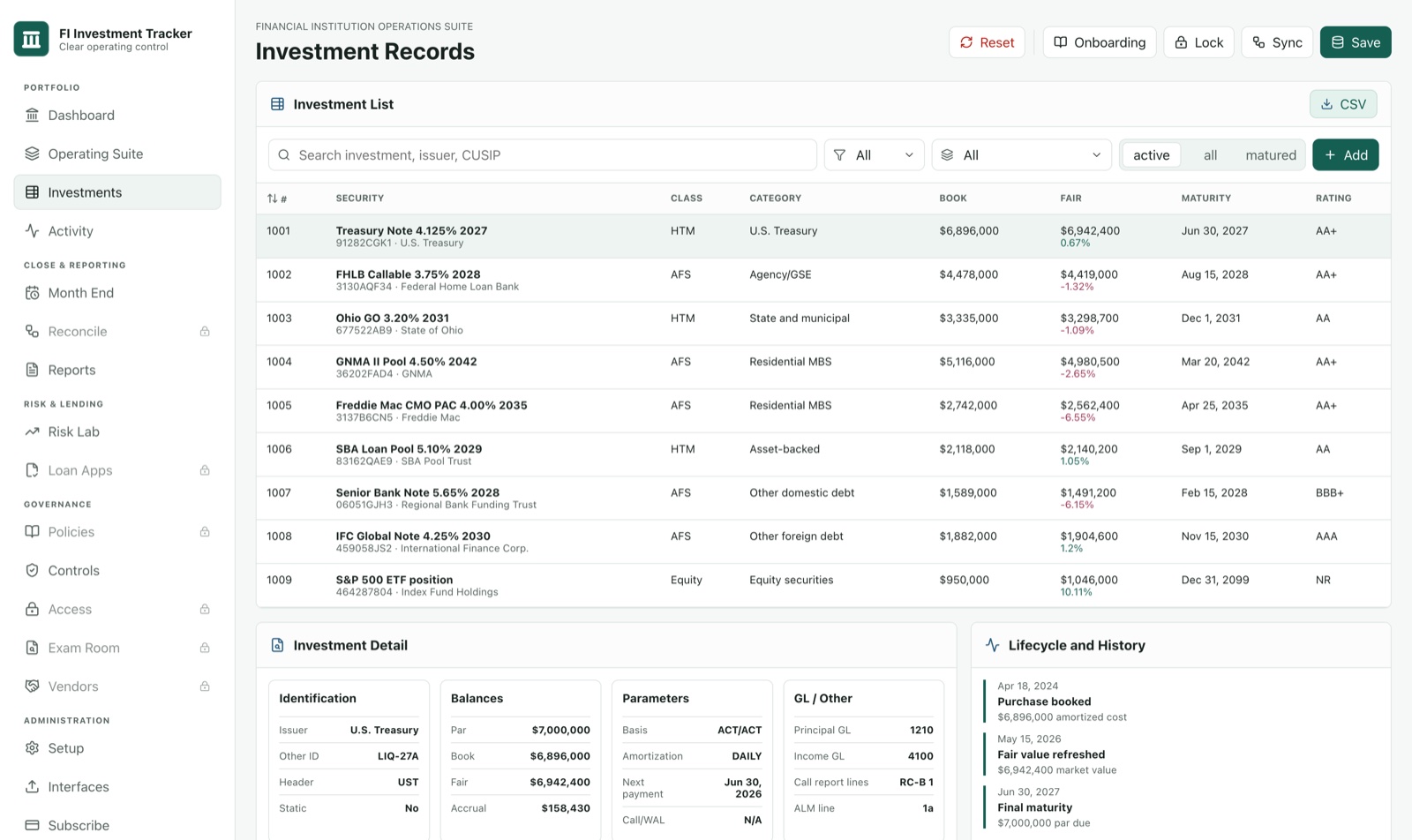
FI Investment Tracker is a local-first securities subledger for credit unions and community banks: effective-interest amortization, factor-based paydowns, month-end close with a GL tie-out, and call-report support, with your portfolio data staying in an encrypted database on your own machine. Pricing is published, checkout is self-serve, and your first working session on your own data is the evaluation.
Next: the buyer's guide to evaluating investment subledger software, including the questions to ask any vendor. Related: when a spreadsheet stops being adequate, replacing a legacy investment tracker, NCUA 5300 and FFIEC RC-B investment support, and the investment accounting software overview. Questions about a post-conversion cutover: [email protected].